Runtime
Confirm Node and npx availability, package policy, agent compatibility, and whether your first run belongs in a sandbox. Inspect package identity and terminal prompts before allowing changes.

Install help
This documentation page has no sales form. Review the environment, connectors, and first task before copying the installer.
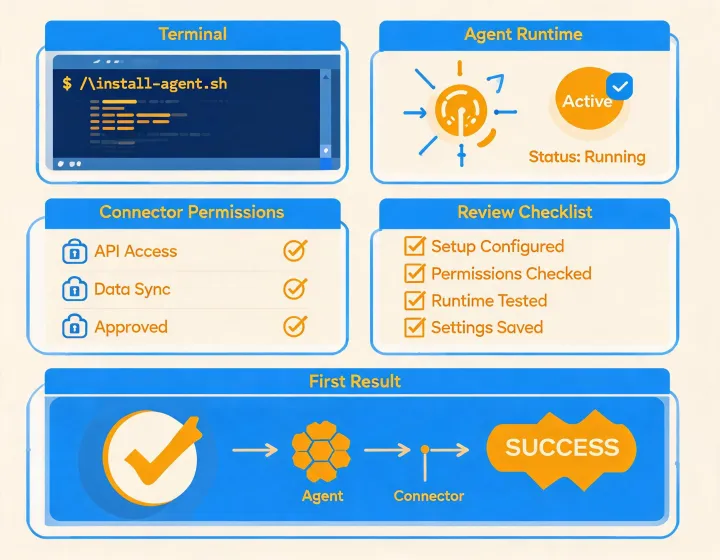
Confirm Node and npx availability, package policy, agent compatibility, and whether your first run belongs in a sandbox. Inspect package identity and terminal prompts before allowing changes.
Use only approved sources and destinations. Keep keys in the secret store with narrow scopes. Review platform terms, API rate limits, browser-automation risk, logging, retention, and revocation.
Choose a small authorized sample. Define ICP, exclusions, geography, evidence threshold, message purpose, suppression, and the reviewer responsible for each external action.
Copied, run, configured, and first result are separate states. Copying changes only the clipboard. Running invokes the installer. Configuration grants selected access. A first result returns research for review; it does not establish permission to contact someone or guarantee a reply.
Use the initial task to inspect provenance, checked time, identity uncertainty, and sensitive inference. Reject context that a recipient would not reasonably recognize. Keep connection requests, follow-ups, email, exports, and CRM writes behind distinct approvals.
Before production, test reply routing, opt-out, suppression, correction, and deletion. Removing a package does not automatically remove data from agent logs, files, CRM, engagement tools, or providers. Document those stores and revoke credentials separately.
Run a failure rehearsal as well as a happy-path test. Check what happens when a source is unavailable, a profile match is uncertain, a connector reaches its rate limit, a browser interface changes, or the agent proposes a message outside the approved tone. The workflow should pause visibly rather than silently retrying an external action.
Finally, assign operational ownership. Someone must review changing platform terms, approve connector updates, monitor account warnings, maintain suppression, and investigate complaints. Record the date and scope of each review so a later operator can understand which assumptions were current when the playbook ran.
The button copies text; it does not run software.
npx -y @okki-global/okki-go-taroball